"I Thought I Was Cooked": How a Self-Described Non-Collegemaxxer Got Into Yale
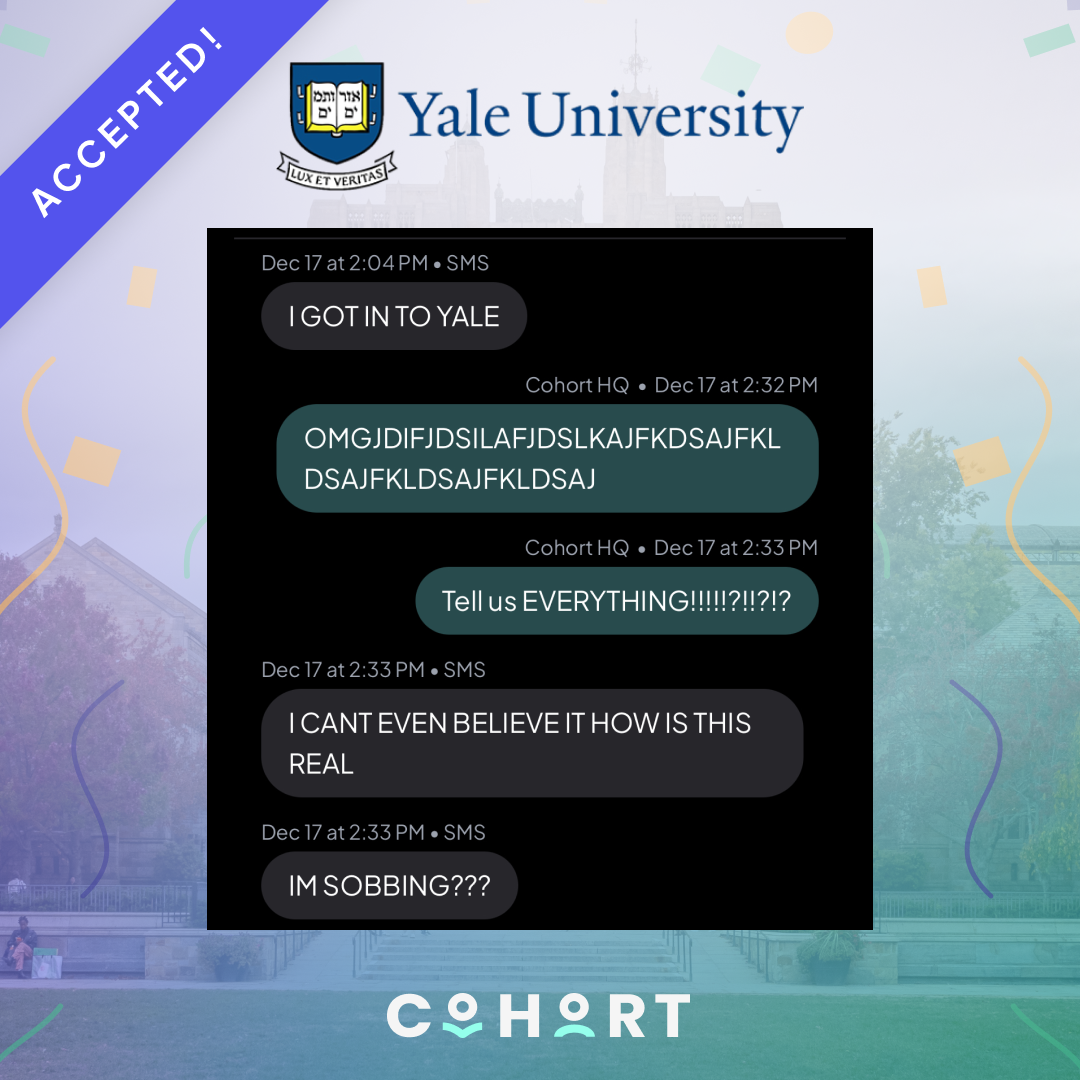
Saanvi Sharma shares her story — from science fair and speech & debate to REA acceptance.
When Saanvi found out she got into Yale, she was alone in her house, sitting under her covers at 2 p.m. She'd left school early, fully expecting a deferral at best.
"I was tweaked out of my entire mind," she told us. "I was preparing to just grind out all these apps over winter break. In my area, it's pretty unheard of for people to get in early — even if you're a good student, it's just really hard to hit a home run like that."
Then the status update loaded, and the Yale Bulldog song started playing.
"I screamed. I actually screamed. Then I called my mom at work — she picked up and said 'what, what?' And I was like, no, I got in. I flipping got in."
Later that day, she went back to school for a club meeting. She'd emailed her chemistry teacher to thank him for her letter of rec — and he, unable to keep the secret, announced it to the entire class.
"That's how everybody found out."
Not a "Collegemaxxer" — By Design
Ask Saanvi what her college prep strategy was, and she'll laugh a little.
"I definitely was not one of those people who knew exactly what they wanted to do freshman year. My philosophy was just: do the things I like. If I like it, I stick with it. If I don't, I drop it."
Her two main school ECs were science fair and speech & debate — both of which she'd started in middle school, simply because she enjoyed them. Outside of school, she'd been dancing since she was four, playing piano since she was seven, and doing taekwondo since she was seven. She also sings.
"I'd never be able to tell you what my favorite EC was. I just liked doing things."
She tried a CS class freshman year. Hated it. Joined HOSA and an intro to law class. Liked both. Did research not to rack up accolades, but because she genuinely wanted to understand what she was studying — and discovered in the process that she actually loved wet lab chemistry.
"If I hadn't done research in chemistry, I would never have known I wanted to pursue it as a major."
On the awards front, Saanvi is quick to set the record straight: she never went to ISEF, never got anything published, and didn't walk into Yale with a shelf full of national science fair trophies. For debate, she made it to semi-finals at Nationals two years running — remarkable for a school with no debate coach, no funding, and a student-led club.
"We went to TOC my freshman year and got absolutely whipped. Like two and five. But I don't regret it at all. You just learn so much."
On Research: The Wrong Mindset Is Everywhere
One of the sharpest things Saanvi said was about how students approach research — and why it so often backfires.
"The mindset I see a lot is: I'm going to do research to get to ISEF, to get into an Ivy. And I just vehemently disagree with that approach."
Her own research wasn't decorated. But it was genuine. She applied to internships in areas she actually cared about, investigated questions that felt meaningful to her, and submitted a research supplement to Yale that had no external validation attached to it — just honest findings and real-world curiosity.
"Please just have a genuine curiosity for whatever it is you're researching. A lot of students default to research as the path to an Ivy. But a lot of my friends got into Ivies early and they weren't research-maxing."
Her advice: think outside the box, reach out to professors and internship programs, and only pursue research in something you'd want to understand even if no one was grading you on it.
On Debate: The Gambler's Mindset
For speech and debate, Saanvi's advice is simpler: don't quit before you make it big.
"You can't quit before you make it big. And if the event you're doing isn't working out for you, switch events. There are so many."
She also pushed back on the idea that you need a powerhouse program to go far. Her school had no coach and no budget. What it had was a supportive group of students who figured it out together.
"There's always going to be somebody who has more time to put in and gets better outcomes. Don't take that personally. Do events because you like them — not because you think they're easy to win or strategically advantageous."
What She Actually Needed Help With
By junior year, Saanvi knew her essays were the weak link.
"I'm a really bad essay writer. And I knew that was a really important part of college apps. So I started looking around."
She found Cohort through a Discord post. The price was a factor — every other service she'd looked at wanted what she described as "an arm and a leg." But what actually sold her was the structure: real, face-to-face conversations about her essays, not just comments in a Google Doc.
"I kind of need to hear the advice. Talk it out. Be like, okay, what's the best part of this? That's just how I learn."
Over the course of the process, Saanvi went through 19 drafts of her Common App essay. She changed the topic entirely halfway through — different subject, different writing style, starting over. Her mentor entertained every direction, gave honest feedback, and helped her find the version that actually felt like her.
"There is nothing on my college app that isn't me. Nothing I'd look at and say, that doesn't seem like who I am."
The office hours also gave her something harder to teach: accountability. She'd book a session, and suddenly she had a deadline.
"If there's no ticking time bomb, I just have no intrinsic motivation. So I'd proactively book office hours so that I always had something new to bring to the table."
Cutting Through the Noise
As a first-generation applicant with immigrant parents, Saanvi had no insider knowledge of how the process works. Her information sources were Reddit, YouTube, and whatever she could find online.
"I'd see stuff like, 'What do you mean a 4.0 valedictorian didn't get into University of Florida?' And I was scared."
The Cohort workshops helped her stop doom-scrolling and start filtering.
"Once I started going to the workshops, I was just like — goodbye, all of you. I'm not listening to this anymore. Because a lot of these companies online just want to profit off of you. They're not actually trying to give you useful information."
She also valued being able to ask the small questions — the ones that feel dumb but actually matter. How to order your extracurriculars. Whether a 1510 is good enough. How to frame your honors section.
"The average admissions officer is spending maybe five minutes on your application. Having someone look over those tiny details that you might miss — that's actually what matters."
What She'd Tell a Parent on the Fence
Saanvi's pitch is direct.
"A lot of other admissions services are charging ten grand for the Common App, then another five grand per supplement. That's just not realistic for most families."
But more than price, she'd push back on the "does my kid even need this?" question.
"The thing is, there's so much conflicting information out there, and a lot of it is noise. Having workshops, mentors, office hours, essay feedback — it cuts through all of that. You have someone who can actually answer your questions."
And someone who works with who your kid already is — not a mold they're trying to pour them into.
"My mentor never told me to change my essay topic or write about something I didn't care about. He just helped me make what was already there better."
The student in this article is identified by the alias Saanvi Sharma to protect her privacy. All other details reflect her real experience.