Why Is College Counseling So Expensive?
If you've ever looked into hiring a college counselor and done a double-take at the price tag, you're not alone.
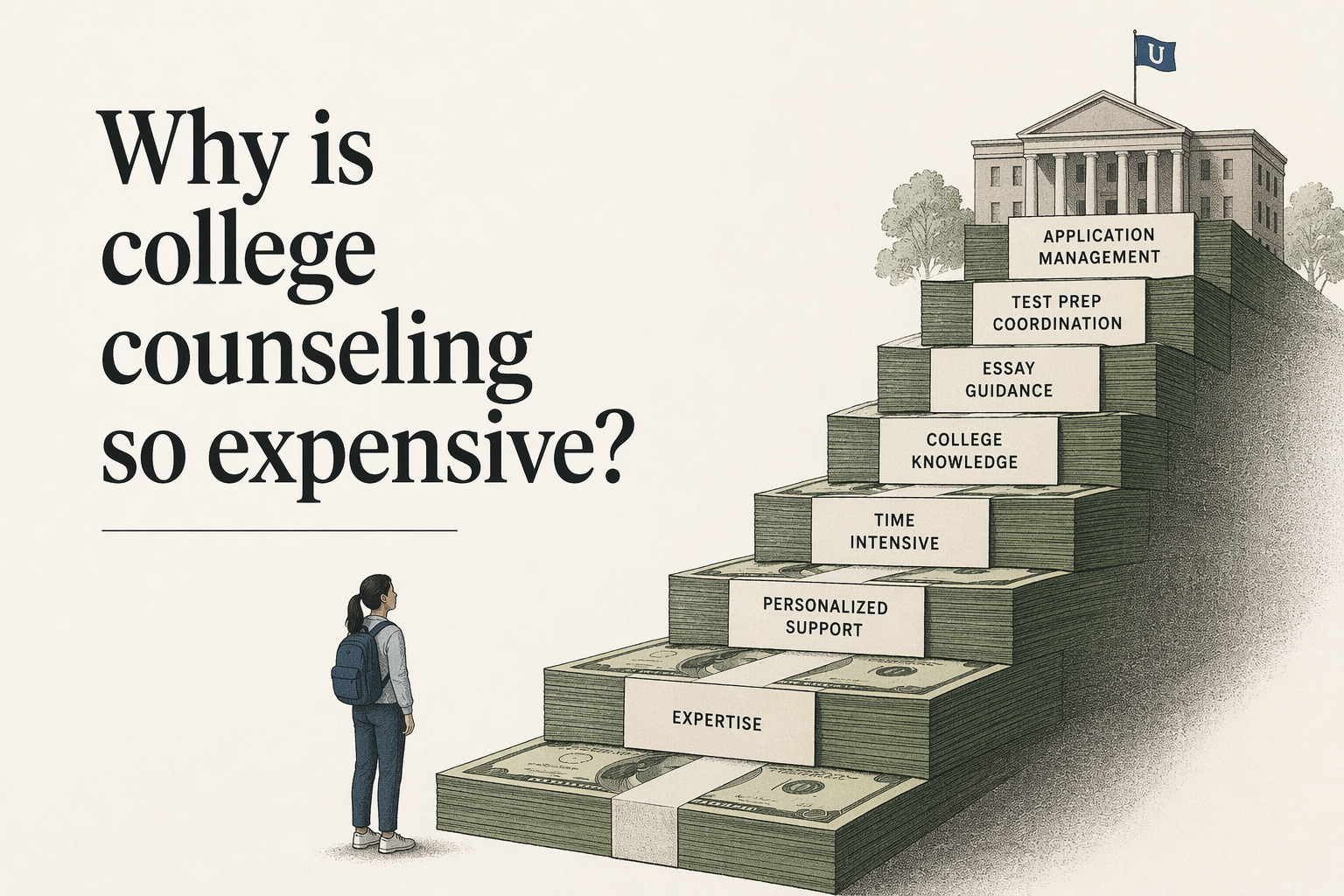
The average college counseling package runs $6,000–$7,000, according to the Independent Educational Consultants Association (IECA). But that's just the average. Some firms charge $10,000. Some charge $30,000. A handful charge $100,000 or more — and yes, there are documented cases of families spending $750,000 on college admissions support.
So what's actually going on? Is the expensive option worth it? And what should your family actually do? Here's an honest breakdown.
First: Most College Counselors Genuinely Want to Help
Before we get into the economics, it's worth saying this clearly: the vast majority of college counselors go into this field because they care about students. The high prices aren't usually a sign of bad intentions — they're a byproduct of how the business model works.
In fact, many counselors would love to serve more students from diverse economic backgrounds. The problem is that the traditional model makes it structurally hard to do that. To understand why, you need to understand the math.
The Economics of College Counseling: A Simple Equation
A college counselor's income comes down to one formula:
Income = Number of Students × Price Per Student
The average independent counselor charges $200–$300 per hour and works with anywhere from 15 to 40 students per year — though caseloads and pricing vary widely.
Here's the constraint: every counselor only has so many hours in a day. Their time gets split between student meetings, college campus visits, ongoing research, and running their business. There's a hard ceiling on how many students one person can meaningfully serve.
That leaves price as their biggest lever for increasing income.
Over time, the most successful counseling firms figured out something counterintuitive: college consulting can behave like a luxury good. Raise the price, and demand actually goes up. The perception of exclusivity attracts high-achieving, well-resourced families. Those families tend to get strong results — for many reasons, not all counselor-driven. Strong results reinforce the premium brand. The premium brand justifies higher prices. And the cycle continues.
This isn't unique to college counseling — it's how luxury markets work across industries. But it does mean that price and quality aren't as tightly correlated as you might assume.
Is 10x More Expensive 10x Better?
No.
That's not a knock on any individual counselor. It's just an honest answer to an honest question.
Premium pricing in college counseling typically buys families one thing: more access. More calls. More check-ins. More availability. That's not nothing — but it's not the same as dramatically better outcomes.
A highly experienced counselor charging $5,000 and a boutique firm charging $50,000 are both drawing on the same pool of admissions knowledge. They're both navigating the same Common App. They're both helping a student craft a compelling story. The extra cost usually reflects availability and brand prestige — not a fundamentally different approach.
So why do families pay it?
Because most families at that price point aren't expecting 10x better results. They're paying to feel less anxious. College admissions is high-stakes, emotionally charged, and opaque. When anxiety is driving the purchase, price becomes a proxy for safety — even when it isn't.
What Does That Mean for Your Family?
It means you might be asking the wrong question.
Instead of "Can we afford the expensive option?" — ask yourself: "What are we actually paying for, and is that what our student needs?"
More access to a counselor isn't always the answer. Sometimes what a student needs most is someone who gets what they're going through — not a professional consultant, but a near-peer mentor who went through the same process recently and came out the other side.
That's the model we built at Cohort. Students work one-on-one with recent college graduates in high-impact careers — mentors who've been exactly where they are. Paired with structured curriculum and AI-powered tools to manage the process, it's a fundamentally different approach to college advising. Not more hand-holding. Better guidance.
Different model. Fraction of the cost.
If you want to know if Cohort is the right fit for you, schedule a call with us!